What is conversational AI latency and what impacts it?
- Written by
- Jack Limebear
- Published
- Last updated
ListenListen to this article
For conversational AI, latency is what separates good applications from great ones.
Conversational AI is, by nature, aspirational. It looks to emulate the same feeling as conversing with a human, mirroring the same emotional range, pitch, and cadence as it does so. Add in what feels ‘natural’ as a delay between when you stop speaking and when an AI agent starts responding, and you have a latency target grounded in how humans actually communicate.
Businesses that want to deploy conversational AI agents at scale need to reduce that latency as much as possible if they want to achieve that natural illusion. This article covers what conversational AI latency is, what causes delays across the entire pipeline, and a high-level overview of how to reduce them.
Summary
- Conversational AI latency is the total end-to-end delay from when a user stops speaking to when they hear the agent’s first word.
- Agents with above 700 ms may feel unnatural, with those over 1,200 ms having high abandonment rates.
- Latency accumulates across every stage of the conversational AI pipeline.
- ElevenAgents handles the full pipeline in a single, unified architecture, making low-latency conversational AI accessible for your business.
What is conversational AI latency?
Conversational AI latency refers to the total time it takes for a system to respond after you’ve spoken. For modern AI models, latency is measured in ms. Behind the scenes, the total latency figure is actually made up of several separate processes, each of which supply part of the end-to-end pipeline.
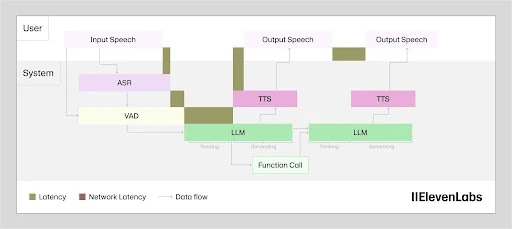
A typical conversational AI pipeline looks like:
- A user speaks
- The audio is transcribed by a speech to text model
- Transcript is passed to an LLM model, which produces a response
- The LLM’s text is then synthesized into audio with a text to speech model
- The audio is then played to the user
Every single one of these stages adds latency to a conversational AI system. Due to that, when discussing latency, there are a few different acronyms to clarify.
Model inference latency
Model inference latency is the time a model spends generating output, measured internally and excluding all external factors. It’s the model-specific measure of how quickly your engine performs for typical inputs. For example, Flash v2.5 has a model inference latency of around 75 ms. Knowing that, you can compare how quick models are across competitors.
That said, remember that this isn’t the latency figure that a user actually experiences. It’s specific to the total time a model spends generating output.
LLM time-to-first-token
Large language model (LLM) time-to-first token (TTFT) is the total time it takes for a large language model to process a prompt and generate its first usable token of output.
TTS generation begins when the first token arrives from your LLM, so this is a measure of how long the LLM takes to begin prompting your TTS model to run. For most end-to-end conversational AI systems, LLM TTFT is a significant portion of total latency.
TTS time-to-first audio (TTFA)
TTS time-to-first audio (TTFA) measures the time from the first TTS request to when the first audio chunk actually leaves the model. It’s a way to describe model inference latency but specifically for TTS engines.
End-to-end time to first audio (TTFA)
The end-to-end TTFA is the total conversational AI latency. It’s the sum of every single part of the pipeline, ranging from speech recognition, LLM TTFT, TTS, TTFA, and all the network transmits between steps. When discussing conversational AI latency as a whole, this is the metric that the user feels.
When they speak, they’ll be waiting for the end-to-end TTFA before they hear anything back from your agent. It’s a holistic measure, meaning improving any part of the pipeline will improve it.
Why conversational AI latency matters
When a user talks to your AI agent, latency becomes a central factor in how they view that experience. Low latency times reduce how long your user has to wait for a response, helping the conversation to feel natural and your agent to seem capable.
Agents that have high latency feel artificial and less competent, even if the quality of their responses is the same. For businesses, even the difference of only a few 100 ms can feel like an eternity, making your customer support agent feel clunky and ineffective.
Here are a few different scenarios to demonstrate why conversational AI latency matters in action:
- Under 500 ms: A conversational agent feels responsive and streamlined. Users may not detect the delay between when they stop speaking and when they first get a response, allowing the conversation to flow smoothly.
- 500 ms to 1000 ms: The delay between when a user stops speaking and when they get a response may become palpable. It’s just slightly too long, meaning users might try to preemptively adjust by repeating themselves or pausing to see if the agent has actually understood them.
- Above 1000 ms: Delays start to feel slow, with pauses that leave some users feeling like the AI agent isn’t fully keeping pace with the conversation. Transcripts may show occasional interruptions or requests to speak to a human agent. In some cases, users may abandon the call.
Every single one of these thresholds translates into real business outcomes.
On the lower end of the latency spectrum, you’ll have a customer service agent that can naturally field incoming questions and help users resolve their queries without additional help. It takes strain off your human agents and keeps customer satisfaction high. On the higher end of the latency spectrum, you’ll frustrate your customers with an agent that seems to hesitate for far too long.
We’ve defined the voice agent latency budget benchmarks in another article to demonstrate what good latency looks like at both P50 and P95 values.
What causes conversational AI latency?
Conversational AI latency is a term that summarizes several different processes that happen, with each segment contributing to the whole. With that in mind, the bottleneck to low-latency is more of a system-level problem than one that’s solved by simply choosing a better model. After all, several models interact with the pipeline.
For developers, we’ve written an in-depth technical guide on voice agency latency optimization that you can use to improve every stage of the end-to-end time to first audio (TTFA).
Beyond the core pipeline, other factors like telephony and function calling also add latency, even though they’re not internal to the model infrastructure.
Here’s an overview of all of the factors that contribute to conversational AI latency.
Automatic speech recognition
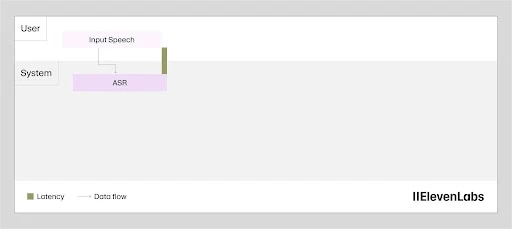
Speech recognition's latency is not the time it takes to generate a transcript. The transcription process runs in the background while the user speaks, so by the time speech ends, the text is largely ready.
The latency here is actually the gap between when speech ends and when the transcript is finalized and passed to the next stage. Scribe v2 Realtime closes this gap to approximately 150 ms, streaming continuously so the output is ready the moment the turn ends.
Turn-taking and endpointing
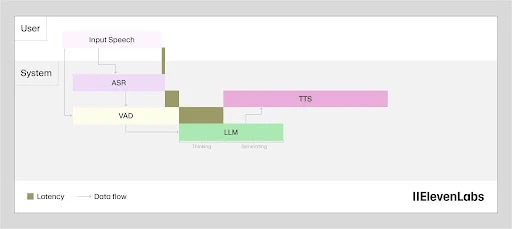
A Voice Activity Detector (VAD) sits between speech recognition and the language model. Its job is to decide when the user has actually finished speaking.
To avoid errors, the VAD waits for a threshold of sustained silence before declaring the turn over, and that wait is latency added before the language model processes a word. That little extra latency does add time, but it also avoids the system beginning to respond while the user is still speaking.
Technically speaking, if all of the other conversational AI components incurred zero latency, the latency attributed to turn-taking would be a good thing. Humans take a beat before responding to speech. A machine taking a similar pause gives realism to the interaction. However, since other components of conversational AI already incur latency, minimal latency is ideal.

Language model processing
Once the transcript is ready from the speech to text (STT) engine, the language model generates a reply. Latency here is the time it takes to start generating tokens, not to generate the full response. Those tokens stream directly into the TTS stage as they arrive, so what matters most is TTFT.
Beyond model choice, both prompt length and knowledge base size affect this stage. The more context the LLM has to consider, the longer it takes. When designing these systems at scale, you’ll want to strike the right balance between a useful knowledge base and a lean prompt to keep things fast.
Speech synthesis
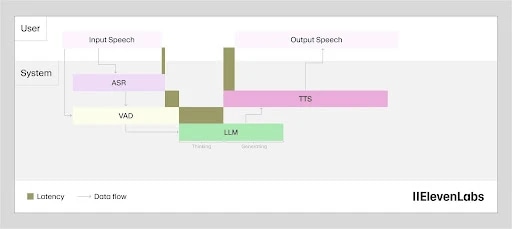
TTS latency is the time between receiving the first tokens from the language model and when audio begins. Because tokens arrive faster than human speech plays, the synthesis model never waits for the full response. TTS latency is strictly the time to first audio chunk.
This stage used to be the largest single contributor to conversational AI latency, with older models taking 2-3 seconds to begin generating speech. ElevenLabs’ Flash v2.5 addresses this directly, delivering speech synthesis with ~75 ms latency and reducing that bottleneck down from seconds to a fraction of a second.
Network latency
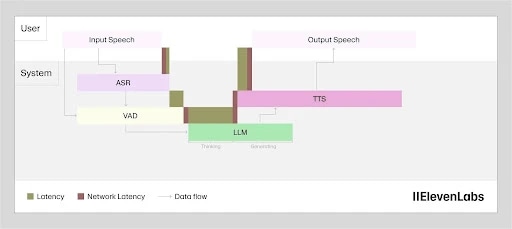
Sending data from one location to another always adds latency, with geographical distance only exacerbating round-trip network latency.
Due to several components working together for an end-to-end response, significant latency can accumulate over several sets of network hops.
Function calling
Function calls add API round-trips at the LLM stage. A fast internal lookup adds tens of milliseconds, while a payment processor or inventory system could add seconds. The amount of latency depends entirely on the service being called, which makes this the hardest stage to optimize directly.
The most effective pattern is to prompt the LLM to respond before the tool call completes. A phrase like "Let me check that for you" keeps the user engaged while the external call resolves, rather than leaving silence. The voice response starts while the tool runs in parallel.
How to reduce conversational AI latency
Reducing conversational AI latency requires addressing each pipeline stage in order of impact. While single improvements you make do impact latency, you’ll need to work on the entire pipeline holistically to see the biggest change.
Here are a few principles that can guide you toward reducing conversational AI latency at a high level:
- TTS model selection: Speed-optimized TTS models like Flash v2.5 use different architectures than quality-optimized models like Eleven v3. For real-time voice agents, the right choice is the highest-quality model that meets your latency target, which is almost always one optimized for speed.
- LLM model selection: Smaller, faster LLMs generally produce lower time-to-first-token than larger ones. Selecting the fastest LLM that still meets your quality bar for the task matters just as much as TTS model choice.
- Streaming: Streaming TTS returns audio in chunks as synthesis proceeds, so the user hears the first word while the model is still generating the rest. This concept also applies to the LLM output, beginning TTS synthesis on the first sentence while the language model generates subsequent ones can recover latency from the pipeline.
- System prompt design: Users can streamline system prompts by moving instructions into procedures or workflows, rather than keeping them as part of every decision step. Doing so reduces the amount of context the model has to reason over on each turn.
- Guardrails: Running guardrails in the streaming model lets output start playing before the guardrail check completes, rather than blocking the playback until the check finishes.
- Model collocation: Using collocated models where possible, such as the ElevenLabs Agents stack, keeps components close together so latency isn’t added by hops between separately hosted models.
- Geography: Close proximity between your servers and your users can significantly reduce latency, as this directly cuts the network contribution to end-to-end TTFA.
Beyond these factors, you can use this technical guide on optimizing latency for more detail.
Get started with low-latency conversational AI on ElevenAgents
Conversational AI latency is an enormous consideration to bear in mind when building and deploying agents. With ElevenAgents, latency optimization is built into the process. From overlap techniques to recover time to low model inference latency on individual components, ElevenAgents builds low-latency conversational AI stacks for your business.
At the end of the day, the goal is to create realism. A user needs to feel the ease of talking to a human while getting the benefits of a computer program. By tightening the sub-processes, this is now possible.
Discover more information about ElevenAgents or contact sales to get started today.
.webp&w=3840&q=80)
.webp&w=3840&q=80)